How to Select the Right ERP System for SMEs in Sri Lanka
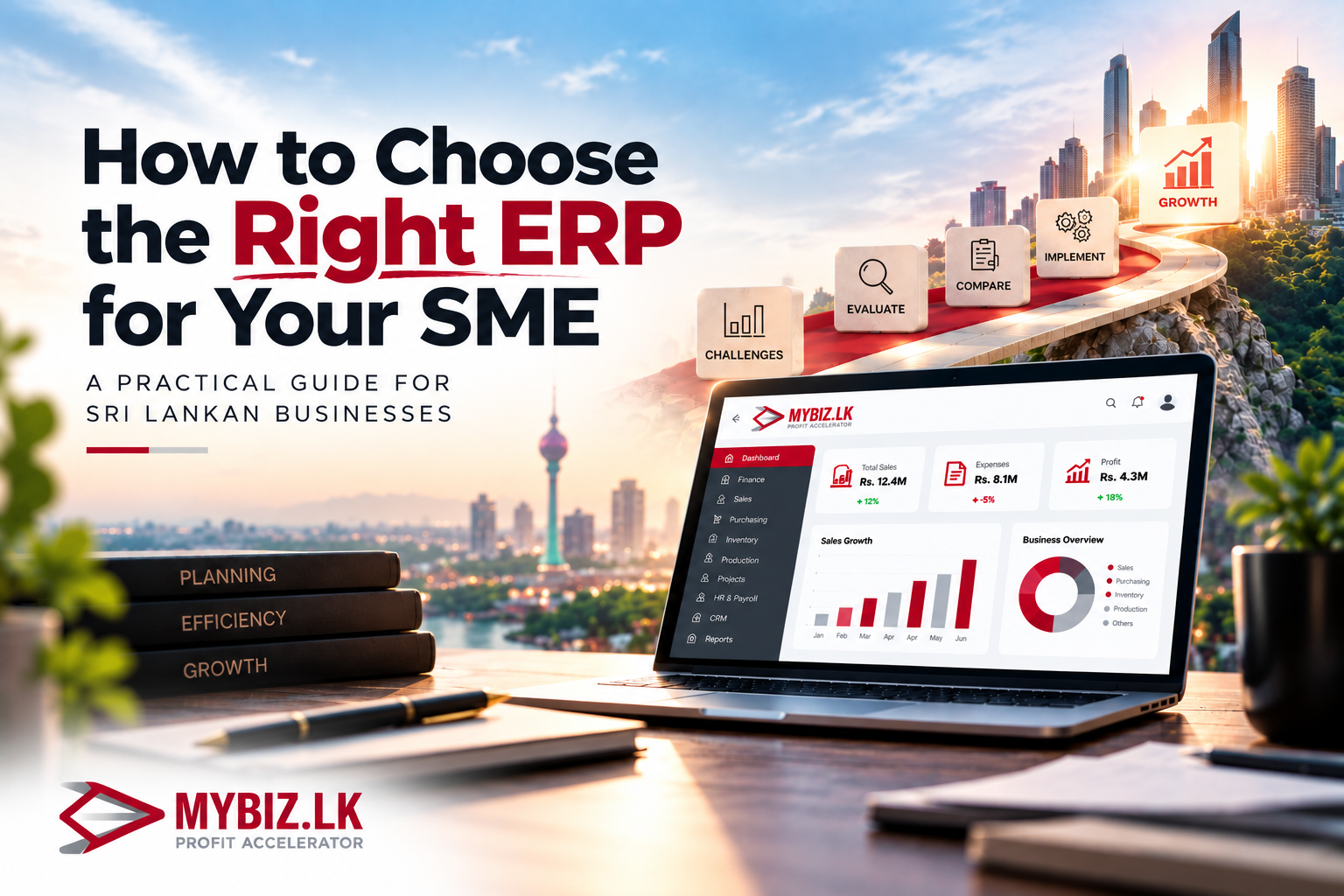
A practical guide for Sri Lankan SMEs to understand ERP, compare international and local ERP solutions, identify the most important selection factors, understand the benefits of ERP, and evaluate MyBiz ERP for their business.
Small and medium-sized enterprises are integral to Sri Lanka's business economy. As they grow, managing finance, inventory, purchasing, sales, employees, production, projects, and reporting via spreadsheets or disconnected systems can be challenging.
Enterprise Resource Planning (ERP) software is designed to provide an integrated environment for core business processes and data. For an SME, however, selecting ERP should not be based on the brand or the longest feature list but on the business itself, its industry, processes, growth plans, people, support needs and budget.
This guide follows a decision path: understand what ERP is, why a growing SME may need it, how to evaluate available options, the benefits the right system can provide and why a Sri Lankan business may consider MyBiz ERP.
1. What Are SMEs. What Is an ERP System?
An SME is a medium-sized enterprise. Sri Lanka's National SME Strategy Framework 2026 identifies the importance of MSMEs to the country's economy. Highlights technology and digital enablement as important areas for SME development.
ERP, or Enterprise Resource Planning, is business management software that links business functions and information within one system. Modern ERP platforms can link areas such as finance, inventory, procurement, sales, human resources, production, projects, assets, and reporting.
Instead of maintaining separate information across Excel files, accounting applications, inventory tools, HR systems, and manual reports, ERP aims to create a connected business environment.
2. Why Should Growing SMEs Consider ERP?
Not every small company needs an ERP system from day one. The need becomes more relevant as the business grows and its operations become harder to control with spreadsheets, manual processes, or disconnected applications.
Common signs that an SME may be ready to evaluate ERP include:
- Business information is maintained in spreadsheets or separate systems.
- Employees repeatedly enter the information in different places.
- Management reports take long to prepare.
- Inventory figures are difficult to reconcile.
- Departments work with versions of the same information.
- Approvals and operational processes rely heavily on follow-up.
Management has limited real-time visibility into costs and business performance.
The important question is therefore not simply "Do we need ERP?" But rather, "Which ERP is appropriate for the way our business operates?"
3. How to Choose the Right ERP for Your SMEs
A starting point for a Sri Lankan SME is to compare two broad options: international ERP platforms and local ERP solutions. Neither category is inherently better. The right choice depends on the company's requirements.
Potential advantages:
- Range of functionality and modules.
- Large technology and partner ecosystems.
- Support for multinational operations.
- Established global. Product roadmaps.
- Points SMEs should evaluate:
- Licensing and implementation cost.
- Implementation complexity.
- Whether the business needs all of the functionality.
- Additional configuration or customization requirements.
Local ERP Solutions
Local ERP providers can be an option when a business values local knowledge, closer implementation support, industry-specific requirements, and easier communication with the provider.
Potential advantages:
- Understanding of the local business environment.
- Local implementation, training, and support.
- Potential flexibility around business requirements.
- Easier communication with the provider.
- Solutions may be designed around industries operating in Sri Lanka.
- Points SMEs should evaluate:
- Vendor experience and product maturity.
- Security and access controls.
- Future expansion capability.
- Integration options.
- Long-term product. Vendor stability.
For Sri Lankan SMEs, a capable local ERP can be a practical choice when local support, industry fit, implementation assistance, and cost are important. However, the actual system and provider should always be evaluated carefully.
The Five Highest-Priority Factors to Consider
1. Industry Fit
A manufacturing company, construction company, hotel, printing business, distributor, and retailer do not operate in the same way. The ERP should support the processes that matter to the business industry.
2. Required Business Functions
Do not select an ERP simply because it offers hundreds of features. Identify the functions your business needs now. May need later, such as finance, inventory, procurement, sales, HR and payroll, CRM, production, projects, assets, and reporting.
3. Scalability and Flexibility
Consider whether the ERP can continue supporting the business as it adds employees, users, branches, transactions, modules, and new operational requirements.
4. Implementation, Training and Support
ERP is not a software purchase. Implementation can involve process planning, configuration, data migration, testing, employee training, and ongoing support. SMEs should understand who will handle each part of the implementation and what support will be available after go-live.
5. Total Cost and Long-Term Value
Do not compare ERP systems using the initial price. Consider software, implementation, customization, training, support, maintenance, integrations, and future expansion. The goal is to find a system that provides long-term value for the business.
4. What Can the Right ERP Bring to an SME?
When an ERP is appropriately selected and successfully implemented, a connected business system can provide potential benefits.
1. Connected Business Information
ERP can bring information from functions into a shared environment, reducing reliance on disconnected data sources.
2. Repetitive Manual Work
Depending on the system and configuration, routine workflows can be streamlined or automated, reducing repeated manual data entry.
3. Better Operational Visibility
Connected information can help management understand what is happening across parts of the business.
4. Reporting and Decision-Making
Access to current business information can reduce the time required to manually consolidate reports and can support more informed decisions.
5. Better Coordination Between Departments
When departments work within processes, information can move more consistently between functions such as purchasing, inventory, finance, sales, and operations.
6. Support for Growth
An ERP can provide a structured foundation for a business as its operational requirements become more complex.
ERP itself does not guarantee these outcomes. Product quality, implementation, data quality, process desi ERP selection. MyBiz ERP serves businesses across a range of sectors, allowing potential customers to evaluate solutions in the context of their operational environment.
5. Why Consider MyBiz ERP for Your SME?
After identifying business requirements and understanding the differences between ERP options, the next step is to evaluate providers against those requirements.
MyBiz ERP is the flagship ERP brand of Csquare Technologies. Positioned around industry-specific ERP solutions. Rather than treating every business as identical, the approach is to support different operational requirements across different industries.
- Industry-Focused Approach
Industry fit is a part of ERP selection. MyBiz ERP serves businesses across a range of sectors, allowing potential customers to evaluate solutions in the context of their operational environment.
- Integrated Business Management
Based on MyBiz product information, relevant business areas can include finance, inventory, purchasing, production, projects, employees, customer activities, and reporting, depending on the solution and business requirements.
- Local Business Understanding and Support
For a Sri Lankan SME, access to a provider can make communication, requirement gathering, implementation coordination, training, and ongoing support more practical. Businesses should confirm the support scope during the evaluation process.
Industries Served by MyBiz ERP
- Manufacturing
- Construction
- Printing & Packaging
- Distribution
- Retail & POS
- Hotel & Hospitality
- Bakery
- Automotive
- Healthcare
- Education
- Jewellery
- Security Services
- Agriculture & Farms
- Transport & Logistics
- Service Businesses
Why Put MyBiz on Your ERP Shortlist?
- Industry-specific ERP positioning.
- Local understanding of Sri Lankan business requirements.
- Connected management of business functions.
- Local. Support capability.
- A product portfolio serving SME industries.
These points should be evaluated alongside your requirements, budget, implementation expectations, security needs, and long-term growth plans.
6. Quick ERP Selection Checklist for SMEs: Does the ERP fit our industry and operating model?
- Does the ERP fit our industry and operating model?
- Does it cover the business functions we actually need?
- Can it support growth and additional requirements?
- Can it integrate with systems we need to keep?
- How will existing data be migrated?
- What training will employees receive?
- What implementation and post-live support is available?
- What security and access controls are provided?
- What is the total cost beyond the purchase?
- Can the provider clearly demonstrate how the solution fits our business?
7. Choose ERP for Your Business, Not the Brand
The right ERP for a Sri Lankan SME is not necessarily the product with the largest number of features or the most internationally recognized name. The right solution is one that fits the company's industry, processes, growth plans, employees, support requirements, and budget.
International ERP platforms and local ERP solutions both have strengths. SMEs should compare them based on business requirements, rather than brand recognition alone.
For businesses looking for a supported industry-focused ERP solution, MyBiz ERP can be included in the shortlist and evaluated against the same selection criteria.
Ready to Choose the Right ERP for Your Business?
Take the next step toward a smarter, more connected, and better-controlled business with MyBiz ERP.
MYBIZ ERP / PROFIT ACCELERATOR
www.mybiz.it.com
[email protected] • +94 7777 21122
Csquare Technologies (Pvt) Ltd.
About Us
At Csquare Technologies (MyBiz.it.com), we help businesses streamline operations with AI-powered automation. With over 15 years of ERP and automation expertise, we’ve transformed workflows across finance, construction, retail, and hospitality. If your organization still spends valuable time on repetitive tasks, it’s time to change.
👉 Consult us today to discover how our AI solutions can save you time, reduce costs, and accelerate profits.
Need help automating your business?
Book a free consultation—roadmap, cost savings, and automation checklist tailored to your business.
Call +94 777 721122 WhatsApp